

- Top
- Management Message
- Sustainability Management
- Environment
- Environment
- Responsibility for Global Environmental Issues Throughout the Product Lifecycle
- Policies and Governance Structure
- Environmental Management System
- Climate Change
- Disclosure Based on the TCFD Recommendations
- Sustainable Products
- Circular Economy
- Reduction of Waste and Recycling
- Water Use and Management
- Reduction of Hazardous Chemical Substances
- Biodiversity Initiatives
- Business Activities and Environmental Burden
- People
- People
- Responsible Procurement with Due Respect for Human Rights
- Human Capital Management
- Policies and Governance Structure(Respect for Human Rights)
- Human Capital Strategy
- Labor Practices
- Occupational Safety and Health
- Supply Chain Management Policy and Governance Structure
- Supply Chain Management Implementation Status and Performance
- Talent Development and Capability Building
- Health Promotion Initiatives
- Promoting and Respecting Diversity
- Mizuno CSR Procurement Code of Conduct
- Sports & Society
- Sports & Society
- Contributing to the multi-dimensional values of sports
- Contributing to the resolution of social issues
- Policies and Governance Structure
- Promotion of Sports and Education
- Embodying Mizunoʼs Unique Identity and Integrated Strength
- Physical and mental health through sports
- Contributing to sustainability through the application of Mizunoʼs technologies
- Trust & Responsibility
- Trust & Responsibility
- Responsible Business Practices
- Responsibility for Safe and High-Quality Products
- Policies and Governance Structure (Product Safety and Quality)
- Corporate Governance
- Compliance / Anti-Corruption
- Protection of Intellectual Property
- Protection of Personal Information
- Ensuring Product Safety and Quality
- Communication Related to Products
- Engagement with Customers
- Sustainability Library
- Our Actions
- Mizuno's Initiatives related to the SDGs
- Purpose / Vision / Values
Environmental Management System
Basic Concept
Mizuno started the unique environmental conservation activities "Crew21 Project" ahead of the rest of the industry in 1991 when global environmental issues began to attract attention. This project was named with the idea of "taking on the role of a crew member of the 'Spaceship Earth' and carrying out activities to conserve resources and preserve the environment." Since the project's inception, Mizuno has been continuing efforts for over 30 years to make effective use of resources, reduce greenhouse gas emissions, and adopt environmentally friendly materials and manufacturing processes in their product planning.
In recent years, as the impact of climate change is increasingly felt, the company's group set a goal in 2021 to achieve net zero greenhouse gas emissions in corporate activities by 2050. To realize this goal, they will further strengthen efforts such as innovations in manufacturing processes and the use of renewable energy. Additionally, they will continue to promote recycling, reduce waste, and use water efficiently as part of their ongoing commitment to environmental sustainability.

System for Promoting Environmental Protection Activities
To promote environmental protection activities across the Group, Mizuno has established an environmental management system, led by its executive officer.
As part of its environmental management system, Mizuno has established the CREW21 Environment Committee, chaired by the Managing Executive Officer in charge of Legal Affairs, with the Executive Officer in charge of Human Resources and General Affairs and the Senior Managing Executive Officer in charge of Product Development serving as vice-chairpersons.
The Committee discusses matters such as the formulation and revision of environmental policies, the establishment of short-, medium-, and long-term environmental targets, and the implementation of specific measures to achieve those targets.
The CREW21 Environment Committee meets regularly and advances environmental conservation activities through company-wide communication and collaboration.
For the primary roles and responsibilities of each organization, please refer to the “Sustainability Governance Structure” section.
Environment Operations Structure

The History of Mizuno's Global Environment Protection Activities
Mizuno recognizes that all business activities have the potential of adversely affecting the environment. Accordingly, to help protect the global environment, in September 1991, Mizuno established a global environment protection activity project titled “Crew21,” and ever since then, it has been putting effort into conducting environmental protection activities. In celebration of the 30th anniversary since initiating the Crew21 project, in April 2021, Mizuno created the logo “MIZUNO CREW21,” which symbolizes all of Mizuno's sustainability activities, including not only its environmental protection activities but also social and economic activities. Mizuno will continue putting effort into helping create a sustainable world as a crew member of the Spaceship Earth.
History of Mizuno's activities for the conservation of the global environment (timeline)

ISO 14001 Certification
The Mizuno Yoro Factory (now Mizuno Technics Corporation), Mizuno's main production site in Japan, became the first in the sports industry to obtain ISO 14001 certification in 1997. This initiative was later expanded to other domestic offices. In 2004, Shanghai Mizuno, the company's largest overseas production base, obtained certification, followed by Taiwan Mizuno in 2008. In 2015, Senoh Corporation and Senotech Corporation, which had joined the Mizuno Group, also received certification.
ISO 14001 certification is primarily applied to sites with significant environmental impact. As of March 10, 2026, the certification coverage rate is 79% for domestic sites and 31% for overseas sites, based on employee numbers.
List of offices that have obtained ISO 14001 certification
| Year of acquisition | Offices that have obtained certification and the scope of application* (as of March 2026) |
|---|---|
| 1997 | Mizuno Technics Corporation
Yoro Factory of Mizuno's Head Office, Haga Factory, Yamazaki RunBird Factory, and Hikami Factory |
| 2002 | Osaka Head Office, Tokyo Head Office, Chubu Branch, Kyushu Branch, and MIZUNO TOKYO |
| 2004 | Shanghai Mizuno Corporation Ltd. |
| 2008 | Taiwan Mizuno Corporation |
| 2015 | Senoh Corporation
Matsudo Head Office and Fukuoka Branch Senohtech Corporation |
| 2020 | Osaka Chayamachi Store |
| 2023 | Senoh Corporation Osaka Branch |
Environmental Audit
Based on ISO 14001, the Mizuno Group conducts internal audits and undergoes external audits by the certification body once a year. According to the examination conducted by the certification body in the fiscal year 2025, Mizuno had no major issues. In addition, Mizuno has already completed resolving all minor issues.
Number of Environmental Audit Findings
| Issues pointed out by Mizuno's internal audit (No. of issues) | Issues pointed out by the certification body's examination (No. of issues) | |
|---|---|---|
| Major issues | 20 | 0 |
| Minor issues | 2 | 4 |
| Opportunities to resolve issues | 2 | 7 |
“Opportunities to resolve issues” refers to advice aimed at making things better, and we carefully review its content before taking appropriate action.
As a result of the ongoing efforts of all Mizuno Group employees, the Group successfully maintained its ISO 14001 certification through the 8th recertification audit in FY2025.
Complying with Environmental Laws and Regulations
To comply with environmental laws and regulations, Mizuno maximizes its environment management system and identifies environmental risks that could be underlying its business. Whenever a risk is identified, to prevent accidents and minimize danger, Mizuno regularly performs maintenance and inspection of equipment and facilities and also conducts emergency response drills.
In fiscal year 2025, Mizuno was not found as violating any environmental laws and regulations, did not experience any major accidents, and was not charged any penalties.
Preventive Approaches and Precautionary Principles
Mizuno strives to prevent environmental impact and reduce the environmental burden at every stage of the process, from planning and development to manufacturing.
In fiscal year 2018, Mizuno conducted an analysis using a life-cycle assessment (LCA) for WAVE RIDER 21, a representative model of running shoes in its footwear business, identifying the processes and environmental aspects that have significant impacts within the product's lifecycle.
In fiscal year 2021, Mizuno carried out LCA analyses on representative products by category, estimated their respective greenhouse gas emissions, and is utilizing these findings in future measures.
Environmental Education
The Mizuno Group provides environmental education to all employees to raise individual awareness of environmental issues. Each department conducts its own training sessions, which help employees understand the company's approach and goals regarding environmental conservation, while also covering a wide range of annual topics.
In addition, specialized training is provided at each site to improve the skills and knowledge required for specific roles, such as waste management personnel and organic solvent users.
Training Topics Include:
- Mizuno's Approach to Sustainability and ESG
- Environmental Conservation Activities
- New Chemical Substance Regulations under the Industrial Safety and Health Act
- Industrial Waste Management, etc.
Disclosure of Environmental Information
Mizuno discloses environmental information on its website. The sustainability report, which includes environmental information, is available in both Japanese and English. The information disclosed on the website can be downloaded as a PDF.
Factory Tours
Mizuno conducts factory tours at its production sites, including the Yoro Plant and Senotech, to showcase its manufacturing expertise and on-site operations. In recognition of World Environment Day on June 5, Mizuno designates June as “Mizuno Environmental Month” and has been organizing cleanup activities around its domestic and overseas offices since 1997.
In fiscal year 2025, a total of 389 visitors from 33 companies and organizations participated in factory tours.

Summer Vacation Factory Tour
Risk Communication
Mizuno Technics is engaged in risk communication through regular dialogue with stakeholders. This effort involves inviting local government officials and residents to actually tour the factory and explaining how the factory operates using various equipment, what products and waste are created, and what environmental conservation activities are being conducted. It's a proactive initiative where information is openly shared with community representatives, and their opinions and requests are actively solicited and incorporated into ongoing activities.
Environmental Workshop
Mizuno conducts environmental workshops designed to foster environmental awareness among children through its manufacturing and environmental conservation activities. The workshops introduce the history of sports equipment and environmental initiatives implemented at Mizuno's manufacturing facilities. Participants engage in hands-on activities such as creating original keyholders from wooden bat offcuts and leftover baseball glove leather, as well as hand-stitching regulation baseballs.

Making Keychains Using Scrap Wood from Baseball Bats

Hand-Stitching Workshop for Regulation Baseballs
Solar panels installed at Mizuno Technics Yoro Factory
The Mizuno Technics Yoro Factory manufactures baseball and golf products, which are Mizuno's core products and other sporting goods and the products made from composite material (carbon material). We installed solar panels on the roof of the factory's largest building, the golf manufacturing building, in January 2023. This will generate approximately 400,000 kWh of electricity per year, which will be used in the manufacturing processes of golf clubs, wooden baseball bats and other products.
We also installed emergency power supply equipment along with solar panels to ensure a stable power supply even in the event of a natural disaster. This emergency equipment not only serves the factory, but is also aimed at benefiting the local community by supplying power to neighboring areas in the event of an emergency.
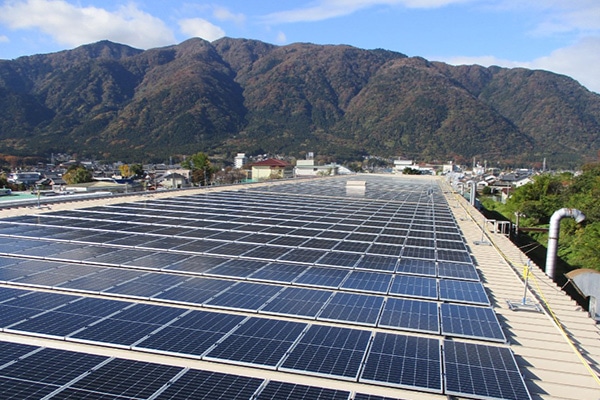
In April 2026, Mizuno Technics Yoro Factory switched its electricity contract to RE100-compliant renewable electricity. As a result, all electricity used in its production activities, other than that generated by its on-site solar power system, is now sourced from renewable energy.
- Responsibility for Global Environmental Issues Throughout the Product Lifecycle
- Policies and Governance Structure
- Environmental Management System
- Climate Change
- Disclosure Based on the TCFD Recommendations
- Sustainable Products
- Circular Economy
- Reduction of Waste and Recycling
- Water Use and Management
- Reduction of Hazardous Chemical Substances
- Biodiversity Initiatives
- Business Activities and Environmental Burden